The Oil Industry Icon Set: Your Visual Toolkit for a Complex Sector
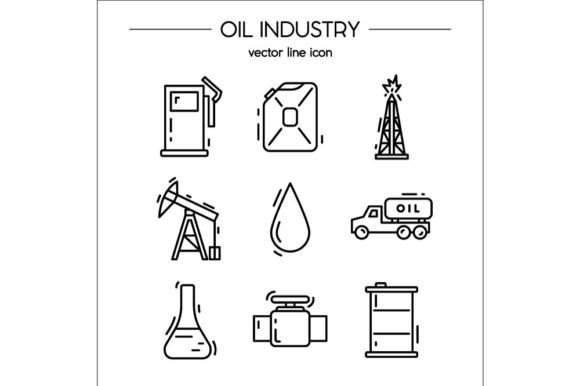
In the world of oil and gas, clarity is paramount. From engineering schematics to investor presentations, professionals constantly need to communicate intricate concepts quickly and effectively. This is where a specialized visual tool, like a dedicated oil industry icon set, becomes indispensable. But what exactly is it? Think of it as a curated library of black-and-white line icons, each representing a core element of the sector—from drilling rigs and pipeline valves to tankers and refinery towers.
As a digital item, this set provides the source files, typically in EPS format for limitless scaling and editing, alongside a JPG preview for quick reference. It’s not a mock-up or a physical product; it’s a functional asset designed for integration into your actual projects. The strength of a monochrome line style lies in its versatility and clarity, ensuring icons remain legible whether on a high-resolution website, a printed report, or a detailed infographic.
Where This Icon Set Finds Its Purpose
The utility of a coherent icon set extends far beyond simple decoration. It serves as a universal visual language, bridging gaps between technical teams, management, and external stakeholders. For instance, a project manager updating a status dashboard can use a pump icon to instantly represent production levels, a pipeline icon for transportation status, and a safety helmet icon to highlight HSE milestones. This visual shorthand transforms dense data into an accessible snapshot.
Consider an environmental consultancy preparing a community impact report. Using clear icons to depict facility locations, water sources, and transport routes can make complex operational footprints understandable to non-technical audiences. The clean, uncluttered nature of black-and-white line art ensures the focus remains on the information, not on colorful distractions.
Adapting to Different Audiences and Industries
The application of an oil industry icon set is remarkably fluid, adapting to the needs of various users within and adjacent to the sector.
- Engineering & Technical Teams: For these professionals, the icons function as diagrammatic elements. They can be used in process flowcharts, P&IDs (Piping and Instrumentation Diagrams), or training materials to symbolize specific equipment or stages. The precision of line art is key here.
- Corporate Communications & Investors: When crafting annual reports, sustainability updates, or investor briefings, financial teams benefit immensely. Icons for “crude oil,” “renewable investment,” or “carbon capture” can visually segment complex financial data, making reports more engaging and digestible.
- Educational & Training Institutions: Academia and vocational training programs use such sets to create clear instructional materials. A textbook explaining refinery processes or an online module on offshore safety is greatly enhanced with consistent, recognizable imagery.
- Marketing & Service Providers: Companies providing services to the oil industry—like software vendors, logistics firms, or equipment manufacturers—can integrate these icons into their websites and brochures. This instantly signals their industry specialization and helps clients visualize their service offerings.
Practical Considerations Before Using an Icon Set
While the benefits are clear, selecting and applying an oil industry icon set thoughtfully is crucial for maximizing its value.
First, assess the completeness and relevance of the library. Does it cover the full spectrum of your needs—upstream, midstream, and downstream? Are there icons for modern concepts like digitalization, IoT sensors, or bioremediation? A set missing key elements of your focus will limit its utility.
Technical compatibility is another vital check. The provision of an EPS source file is a significant advantage, as this vector format allows you to edit colors, adjust line weights, and scale to any size without loss of quality. Ensure your design software (like Adobe Illustrator or CorelDRAW) can utilize these files seamlessly. The JPG preview is useful for quick placement or low-resolution contexts, but the EPS file is where the true flexibility lies.
Also, consider stylistic consistency. A black-and-white line set offers a neutral, authoritative aesthetic. It won’t clash with your existing brand colors, but you must ensure its level of detail matches your application. A highly detailed icon might be perfect for a technical manual but could appear too complex for a mobile app interface.
Balancing Strengths and Limitations
The primary strength of a dedicated oil industry icon set is its ability to standardize communication. It eliminates the time wasted searching for disparate images or creating inconsistent graphics, fostering a professional and cohesive visual identity across all materials.
However, its specialized nature is also a potential limitation. If your work straddles multiple industries—say, oil and renewable energy—you might need to supplement this set with icons from other domains. Furthermore, the black-and-white scheme, while versatile, might not suit projects that inherently require color coding for differentiation. Remember, you can often import the EPS files into design programs and add color yourself, but that requires extra effort.
Another observation is that overuse can lead to visual fatigue. Icons are meant to enhance and clarify, not overwhelm. Strategically placing them to highlight key points in a document or to create logical groups in an infographic is more effective than littering every paragraph with imagery.
Real-World Scenarios and Applications
Let’s move beyond theory into concrete scenarios. Imagine a safety officer developing a new onboarding presentation for offshore workers. Using icons for lifeboats, fire extinguishers, hazardous zones, and communication devices, they can create a visual map of the platform’s safety features, making critical information more memorable than text alone.
Or, picture a data analytics firm building a software dashboard for pipeline monitoring. They could use a network of pipeline icons to represent the physical asset, with valve icons turning red to alert for pressure drops and station icons glowing green for normal operation. This transforms raw sensor data into an intuitive operational landscape.
For print media, a trade magazine article on market trends might use a small set of icons—a drilling rig for exploration activity, a barrel for production, and a truck for logistics—as visual anchors for different sections, helping readers navigate the content quickly.
The oil industry icon set, therefore, is more than just graphics; it’s a problem-solving tool. It addresses the core challenge of simplifying complexity without sacrificing accuracy. By providing a shared visual vocabulary, it empowers professionals across disciplines to tell clearer stories, explain tougher concepts, and design more effective materials, all while maintaining a sharp, professional aesthetic suited to the gravity and scale of the industry they operate in.