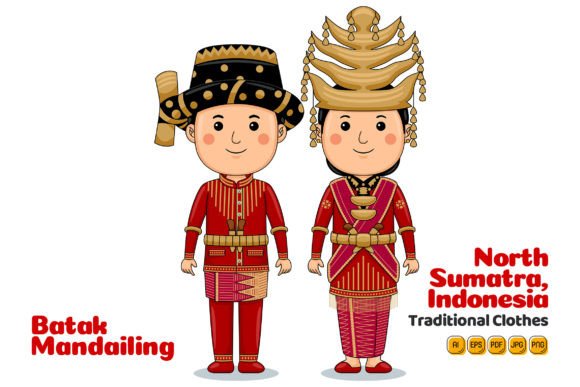
The Geometric Language of Batak Mandailing Cloth: A Modern Design Toolkit
In the highlands of North Sumatra, the Batak Mandailing people have long communicated through a medium of woven symbols. Their traditional cloth, known as "ulos" or specifically "ragi hotang," is not merely fabric; it is a visual lexicon. Each motif—the diamond ("gorga"), the serpent ("naga"), the star—carries centuries of meaning, representing cosmology, social structure, and ancestral wisdom. Today, this intricate geometric language transcends its cultural roots, offering a profound and versatile foundation for contemporary visual communication. The structured patterns of Batak Mandailing traditional cloth provide a unique and coherent system of shapes that can be disassembled, re-colored, and recombined to serve endless modern purposes.
Deconstructing a Visual System for Brand Identity
The core strength of these traditional designs lies in their inherent systemization. A single cloth is composed of repeated, interlocking elements. This makes the motifs inherently modular. A business looking to establish a distinctive brand identity can leverage this. Imagine extracting the precise, angular "gorga" diamond. In its original form, it speaks of protection and strength. For a tech security firm, this shape could be recolored in sleek blues and grays, scaled to form a logo, or used as a recurring border in interface design. The meaning evolves, but the structural authority of the shape remains.
The same applies to the undulating "naga" serpent motif, often symbolizing life force and adaptability. For a wellness brand or a dynamic startup, its flowing lines can be simplified into a modern icon representing growth and resilience. The shapes are not flat illustrations; they are geometric primitives—clean, vector-based forms that are mathematically scalable without loss of quality. This is crucial for branding, which demands consistency across a massive billboard and a tiny mobile app icon.
Adaptation Across Media: From Infographics to Social Posts
Consider the practical workflow of a content creator. An educator developing an infographic on Indonesian cultural heritage can use authentic motifs as section dividers or icons representing different concepts, directly linking the visual to the content. A marketer crafting a social media campaign for a lifestyle product might isolate a single, beautiful star motif from the cloth. Using a transparent PNG file, they can overlay this element on product photos, creating a unique aesthetic signature that feels both artful and authentic.
The high-resolution files ensure that whether the final output is a detailed poster for an event or a compressed image for a website banner, the clarity of the intricate lines is preserved. The ability to change the color of every individual shape is perhaps the most liberating feature. The traditional palette of deep reds, blacks, and whites can be instantly transformed into pastels for a feminine brand, neon shades for a youth campaign, or corporate blues and greens for an institutional report. The design inherits the rhythmic balance and cultural depth of Batak Mandailing cloth, while speaking in a completely contemporary color language.
Building a Custom Illustration Library
For designers and agencies, possessing a library of 100 such vector illustrations is akin to having a bespoke construction kit. Adobe Illustrator compatibility means each AI or EPS file is fully editable. Lines can be thickened, shapes can be merged, and new forms can be built from the old. A designer might combine a series of smaller geometric elements from the cloth's border to create a complex, repeating pattern for a website background. Another might take several motifs and arrange them into a cohesive scene for a landing page hero image, telling a new story with ancient symbols.
This approach moves beyond using a static cultural image as a decorative element. It involves active engagement with the design principles. The motifs encourage experimentation. How might the interlocking patterns inform the layout of a dashboard? Could the symmetrical arrangements inspire the structure of a presentation template? The answer is often yes, because these patterns were originally designed to organize visual information and convey hierarchy—the exact challenges faced in UI/UX design and editorial layout today.
Real-World Applications and Considerations
The use cases are expansive. A researcher publishing a paper on Southeast Asian textiles can use clean vector diagrams of the motifs to aid scholarly analysis. A hobbyist creating custom crafts can integrate the patterns into digital designs for etching or embroidery. A business owner with limited design resources can access pre-made, professional-grade elements to elevate their promotional materials, from PDF brochures to JPG flyers, all derived from a coherent source.
When employing such culturally significant material, consideration and respect are natural companions to creativity. While the geometric forms are open for adaptation, understanding their origin adds depth to their use. Mentioning Batak Mandailing traditional cloth where relevant—perhaps in a design blog post or in the subtle narrative of a brand story—connects the modern work to a rich heritage. It transforms the graphics from mere aesthetic choices into thoughtful dialogues between past and present. This layer of meaning can enrich a brand's narrative, appealing to audiences that value authenticity and cultural intelligence.
The technical specifications—the 4000 x 5500 pixel size, the availability of vector and high-res raster formats—are not just features; they are permissions. They permit unrestricted scaling for large-format printing. They permit easy color manipulation for seasonal campaign adjustments. They permit integration with other software for animation or prototyping. The toolkit is designed not to constrain, but to enable, ensuring that the journey from a historical cloth pattern to a fresh, modern illustration is a smooth and direct one.
Ultimately, the geometric vocabulary found in Batak Mandailing textile art provides a rare combination: rigorous structure and narrative richness. It offers a pre-established harmony of shapes that can be legitimately broken apart and rebuilt according to new needs. For anyone involved in visual communication, from professional designers to entrepreneurial beginners, these patterns represent a reservoir of form. They invite users to not only decorate, but to compose; to not only reference a culture, but to engage with its visual logic and carry it forward into new creations, for branding, for education, and for storytelling in our interconnected digital world.