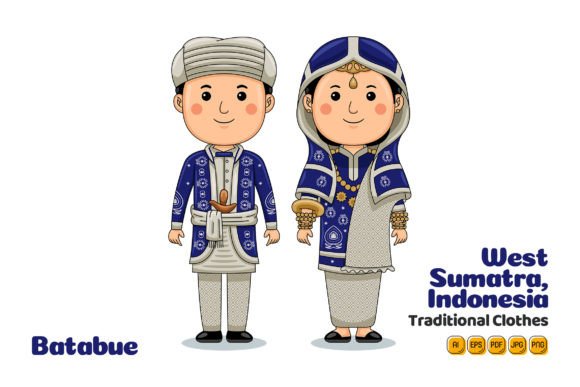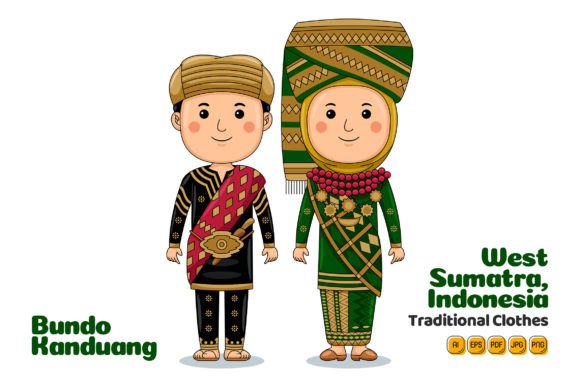
Bundo Kanduang Traditional Cloth: A Cultural Motif for Modern Design
The intricate patterns and profound symbolism of Bundo Kanduang Traditional Cloth represent more than just a cultural artifact from the Minangkabau region. They are a reservoir of visual identity, waiting to be translated into contemporary communication. For designers, marketers, and business owners, these motifs offer a unique foundation for building brand assets that carry weight, story, and distinctiveness.
The Design Potential of Cultural Patterns
Traditional textiles like Bundo Kanduang cloth are inherently designed for storytelling. Every line, shape, and color combination historically conveys specific values, social structures, or natural elements. This built-in narrative depth is what makes them exceptionally powerful for modern illustration purposes. When you begin with a design element that already has meaning, you are not just creating a pretty graphic; you are anchoring your visual communication in a context of heritage and authenticity.
Consider the geometric precision, the balanced motifs, and the harmonious layouts characteristic of such traditional cloth. These are not arbitrary decorations. They are systematic visual languages. For a professional tasked with creating business branding, this systematic nature is a tremendous advantage. It provides a coherent set of rules and a style guide from which countless variations can logically spring, ensuring consistency across all applications.
Unlocking Countless Variations for Brand Identity
The core proposition for using a curated set of illustrations based on Bundo Kanduang motifs lies in infinite adaptability. Having access to 100 vector illustrations means you possess a complete toolkit. Each vector shape, inspired by the cloth's traditional patterns, is a standalone component. The true creative power emerges when you understand that every single element can be resized independently, its color altered to match your brand palette, and its position rearranged.
This is where the practical requirement for files compatible with Adobe Illustrator, alongside EPS and PDF formats, becomes crucial. Professionals working in vector environments need to manipulate shapes without loss of quality. The ability to combine different elements to create your own unique illustrations allows a brand to evolve its visual story over time. A social media post might use a simplified, bold combination of two shapes, while a website landing page might integrate a more complex, layered arrangement of the same foundational elements.
Practical Applications Across Digital and Print Media
The utility of such a versatile asset pack spans the entire spectrum of visual communication. Let's observe its natural fit for specific use cases.
For Infographics and Data Visualization: The structured patterns of Bundo Kanduang cloth lend themselves to organizing information. Individual shapes can become icons representing different data points, sectors, or steps in a process. Their flat design style ensures clarity and readability, even when complex information is being conveyed.
For Social Media and Promotion: Consistency across posts and campaigns is key. Using a family of motifs derived from a single cultural source creates an immediate and recognizable visual thread. A banner for a Facebook event, a series of Instagram story illustrations, and promotional email graphics can all feel cohesively part of the same campaign because they share the same design DNA, even if their final compositions and colors differ.
For Website and Landing Page Illustration: Here, the high-resolution formats and transparent PNG files become essential. Web designers can integrate these elements as decorative accents, section dividers, or prominent hero image components without worrying about pixelation or awkward backgrounds. The inherent elegance of the traditional patterns can elevate a website's aesthetic, moving it away from generic stock imagery.
Technical Specifications for Professional Workflow
A focus on practical understanding demands a clear look at the technical offerings. The provision of AI, EPS, and PDF files for vector illustration ensures that the assets are editable in major professional software, not just locked images. The high-resolution JPG files at a size of 4000 x 5500 pixels guarantee suitability for large-format print needs, such as physical banners or posters, where detail is paramount.
The inclusion of PNG files with transparent backgrounds addresses a common need in digital design, allowing for seamless overlaying on various colored or textured backgrounds. This combination of formats—vector for endless editing and raster for immediate high-quality use—covers virtually all scenarios a creator or business owner might encounter.
Considerations for Ethical and Authentic Use
While the advantages of customization are clear, using motifs from a cultural tradition like Bundo Kanduang Traditional Cloth invites a layer of consideration. It is not merely about aesthetic appropriation. The most respectful and expert application involves understanding the origin. Educators or researchers using these illustrations in their materials might include contextual notes about the cloth's significance. Businesses, especially those connected to heritage, craftsmanship, or Southeast Asian markets, can leverage this connection authentically, informing their audience about the inspiration behind their brand visuals.
This approach aligns with creating content that is not only useful but also trustworthy. It demonstrates a depth of expertise that goes beyond surface-level design. It shows an awareness of the source material's value, which in turn enriches the final branding or illustrative project.
Streamlining the Creative Process
For the hobbyist or the busy business owner, the promise of easy editability is a significant benefit. The phrase "Happy Designing, Happy Purchasing" hints at an intention to remove barriers. A flat design style, by nature, is less complex to modify than a highly textured, photorealistic illustration. Combined with well-organized vector files where each shape is accessible, the process of customization becomes a task of selection and combination rather than of creation from a blank canvas. This can drastically reduce the time and cost involved in producing professional-level custom illustrations for various purposes.
In essence, a resource built upon the patterns of Bundo Kanduang Traditional Cloth serves as a bridge. It connects the rich, ordered visual language of a cultural tradition with the dynamic, varied needs of contemporary digital and print media. It provides a scalable, adaptable, and meaningful starting point for anyone needing to communicate visually with consistency, quality, and a touch of rooted narrative. The outcome is not just a set of illustrations, but a flexible system for building a unique visual identity across countless platforms and projects.