Vector Infographic Presentation: A Practical Tool for Professional Communication
In today’s fast-paced digital environment, the ability to convey complex information clearly and quickly is a significant advantage. For professionals, educators, and marketers, visual communication tools are essential. The Vector Infographic Presentation template represents a specific category of resource designed to address this need directly. It is a pre-designed, editable graphic framework typically packaged as an AI and EPS file, accompanied by a JPEG preview. This package allows users to create structured, visually coherent infographics without starting from a blank canvas. Its core value lies in its adaptability and the professional foundation it provides.
Understanding the Components and Immediate Utility
When you acquire a Vector Infographic Presentation template, you receive several key files. The AI file is for Adobe Illustrator, offering full vector editing capabilities. The EPS file is a versatile vector format compatible with many other design programs. The preview JPEG provides a quick reference. The stated features—editable text, editable vector paths, and the use of free fonts—are critical. This means the core design is not a static image; it is a malleable structure. You can change colors, reposition elements, modify text, and alter shapes without degrading quality. This flexibility transforms it from a simple graphic into a functional tool for producing consistent, high-quality materials.
A Closer Look at the Four-Step Design Framework
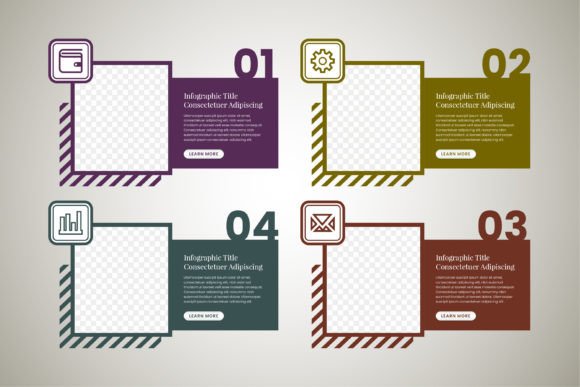
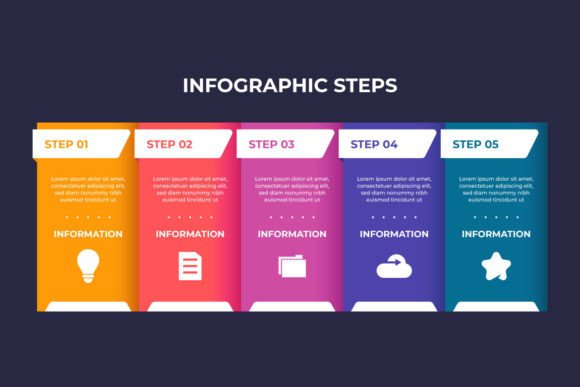
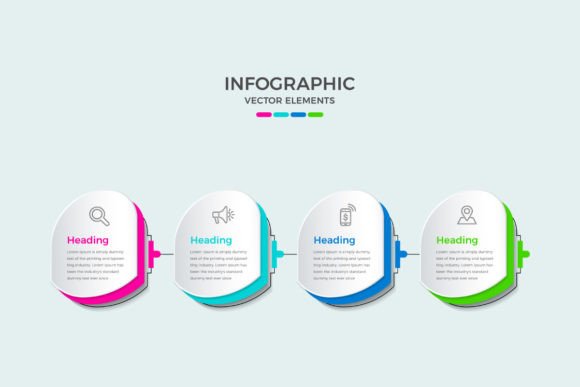
The specific template mentioned utilizes a four-step element design. This is a common and highly effective infographic structure for illustrating processes, timelines, or sequential stages. The template provides a visual scaffold: four distinct, connected segments, each likely containing placeholder text and icons. For someone explaining a business process, a project lifecycle, or a learning module, this layout immediately organizes content logically. The designer’s work is already half-complete; the user focuses on content insertion and minor stylistic adjustments rather than on conceptualizing the layout from scratch. This saves considerable time and ensures a baseline level of visual professionalism that might be difficult for a non-designer to achieve independently.
Evaluating Practical Performance and Real-World Application
How does a Vector Infographic Presentation perform in actual use? Its performance hinges on two main factors: the technical quality of the original vector design and the user’s comfort with vector editing software. A well-crafted template will have clean, logically grouped vector paths, sensible layer naming, and a harmonious color scheme. This makes the editing process intuitive. In practice, a marketing manager could use it to quickly produce a polished “Our Service Process” graphic for a client proposal. An educator could adapt it to create a “Research Methodology Steps” visual for a course handout. The output is scalable—it can be printed large without pixelation and used across web and print media, ensuring reliability across formats.
Key Strengths: Consistency, Efficiency, and Long-Term Value
The primary strengths of such a template are consistency and efficiency. For a small business owner or freelancer without a dedicated design team, using a single, adaptable template for multiple infographics ensures all communications share a unified visual language. This builds brand or presentation consistency. The efficiency gain is substantial; producing a custom infographic can take hours, while adapting a robust template might take minutes. Furthermore, the long-term value is noteworthy. Once acquired and slightly customized to your brand colors, the template becomes a reusable asset in your toolkit. You can return to it for different projects, creating a series of coherent visuals over months or years.
Identifying the Ideal User and Beneficial Scenarios
This resource is not for everyone. It benefits users who have a foundational understanding of vector software like Illustrator or similar alternatives that support EPS files. The target audience includes entrepreneurs creating business plans, bloggers enhancing their long-form content, publishers needing internal workflow diagrams, and educators designing instructional materials. It is particularly suitable for situations requiring rapid turnaround, such as last-minute presentation additions, or for individuals who prioritize clear communication but lack advanced graphic design skills. For a seasoned graphic designer, such a template might serve as a quick starting point or a solution for less creative, more formulaic projects.
Potential Limitations and Considerations
It’s important to acknowledge possible limitations. The template’s effectiveness depends entirely on its initial design quality. A poorly constructed template with messy vectors or overly complex layers can become frustrating to edit. Additionally, while text and vectors are editable, the fundamental layout—the four-step arrangement in this case—is fixed. If your content requires five steps or a radically different flow, the template may constrain you, requiring more extensive modification. The reliance on free fonts is generally positive, but it necessitates that those fonts are installed on your system. Finally, the value proposition shifts if you rarely produce infographics; for a single-use project, the investment in learning to edit the template might not be worthwhile.
Professional Observations on Usability and Effectiveness
From a practical standpoint, the Vector Infographic Presentation shines in its role as a bridge tool. It bridges the gap between non-designers and professional-looking output, and between time constraints and quality demands. Its effectiveness is high for standardized, process-based information delivery. In a corporate setting, using such a template across departments can standardize how processes are visualized, reducing confusion. The editable nature also means it can evolve; a company can tweak the master template slightly each quarter to reflect updated messaging, maintaining both freshness and consistency. However, its effectiveness diminishes for highly creative, narrative-driven, or emotional storytelling infographics, where a unique custom design is preferable.
Making a Decision: Does It Fit Your Needs?
To determine if this Vector Infographic Presentation template fits your needs, consider your workflow, audience, and project frequency. Ask yourself: Do I regularly need to explain steps, stages, or sequences visually? Do I have access to and basic proficiency with vector editing software? Is visual consistency across my materials important? If the answers are yes, this template type is a sensible, practical asset. If your projects are highly varied, your audience expects bespoke artistry, or you have no design software access, it may not be the optimal choice. For the serious hobbyist running a blog or the small business owner crafting investor materials, however, it represents a smart, efficient solution to a common communication challenge.
The Vector Infographic Presentation, particularly the four-step design variant, is a focused utility. It won’t solve every visual communication problem, but for the specific task of structuring sequential information clearly, it offers a reliable, professional, and adaptable foundation. By leveraging editable vectors and text, it empowers users to produce quality work faster, focusing their energy on the content’s message rather than the design’s mechanics. In a world where clarity and speed are paramount, such tools prove their worth through repeated, practical application.